
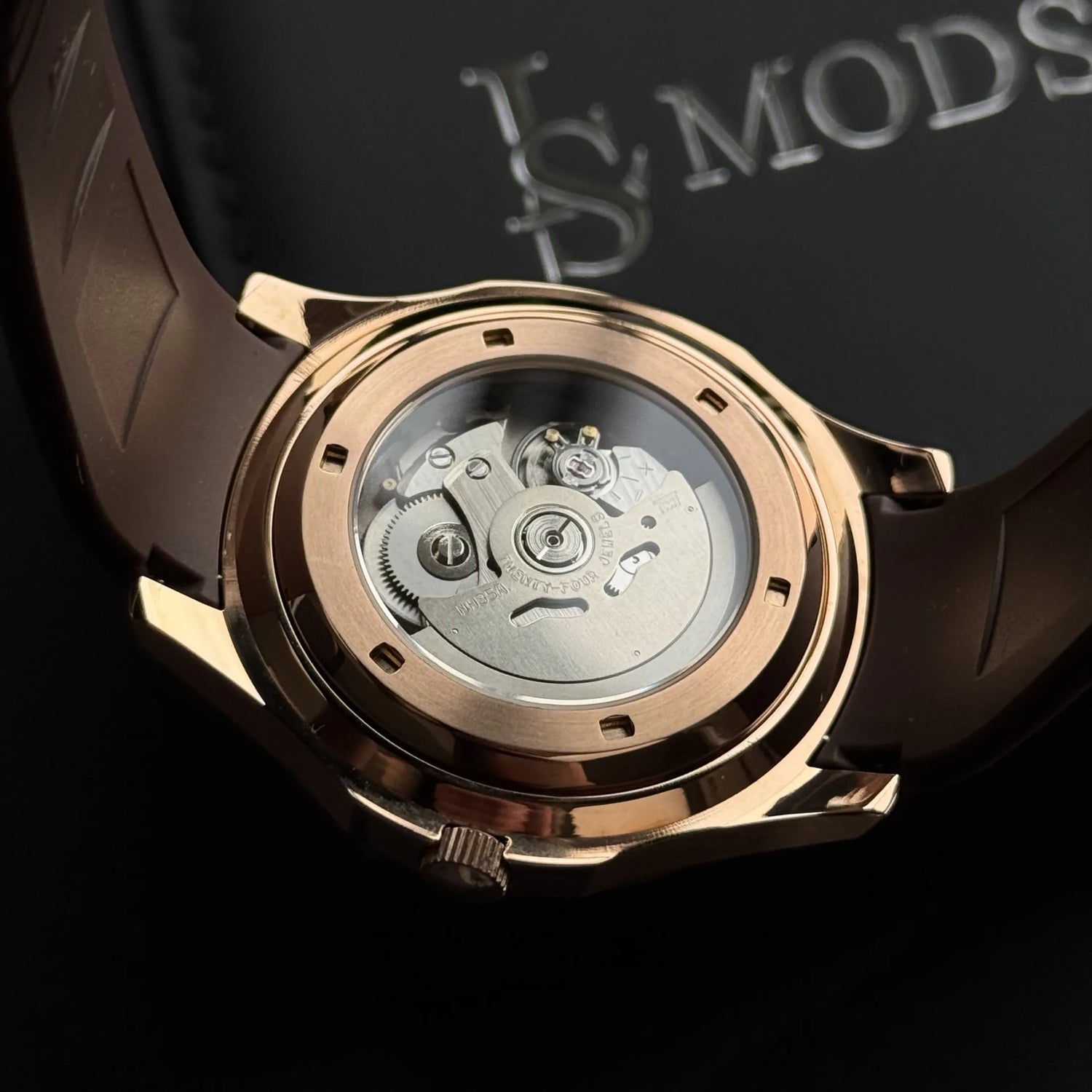
When we talk about SeikoMods, we often focus on the design, finishes, and sapphire crystal. But what truly makes a watch is what's inside. At LSMods, each model is built around a precise Seiko movement, chosen for what it concretely offers the wearer.
NH35, NH38, NH70, NH34, VK63: five calibers, five different philosophies. This guide explains which one is hidden under which model, and why this choice is never arbitrary.
The NH family: benchmark Japanese automatic movements
NH movements are produced by Seiko Instruments Inc. (SII), a Seiko subsidiary specializing in manufacturing calibers for independent brands and third-party watchmakers. This is not at all the same as a low-end generic movement: NH movements are produced in the same factories as mainstream Seiko movements, with the same quality requirements.
All NH calibers share a common architecture: bidirectional automatic winding via a rotor, manual winding possible via the crown, and hacking (stop-seconds) for precise time setting to the second. This solid foundation, documented across millions of units for over twenty years, makes it the benchmark in the SeikoMod world.

The NH35: the heart of the LSMods range
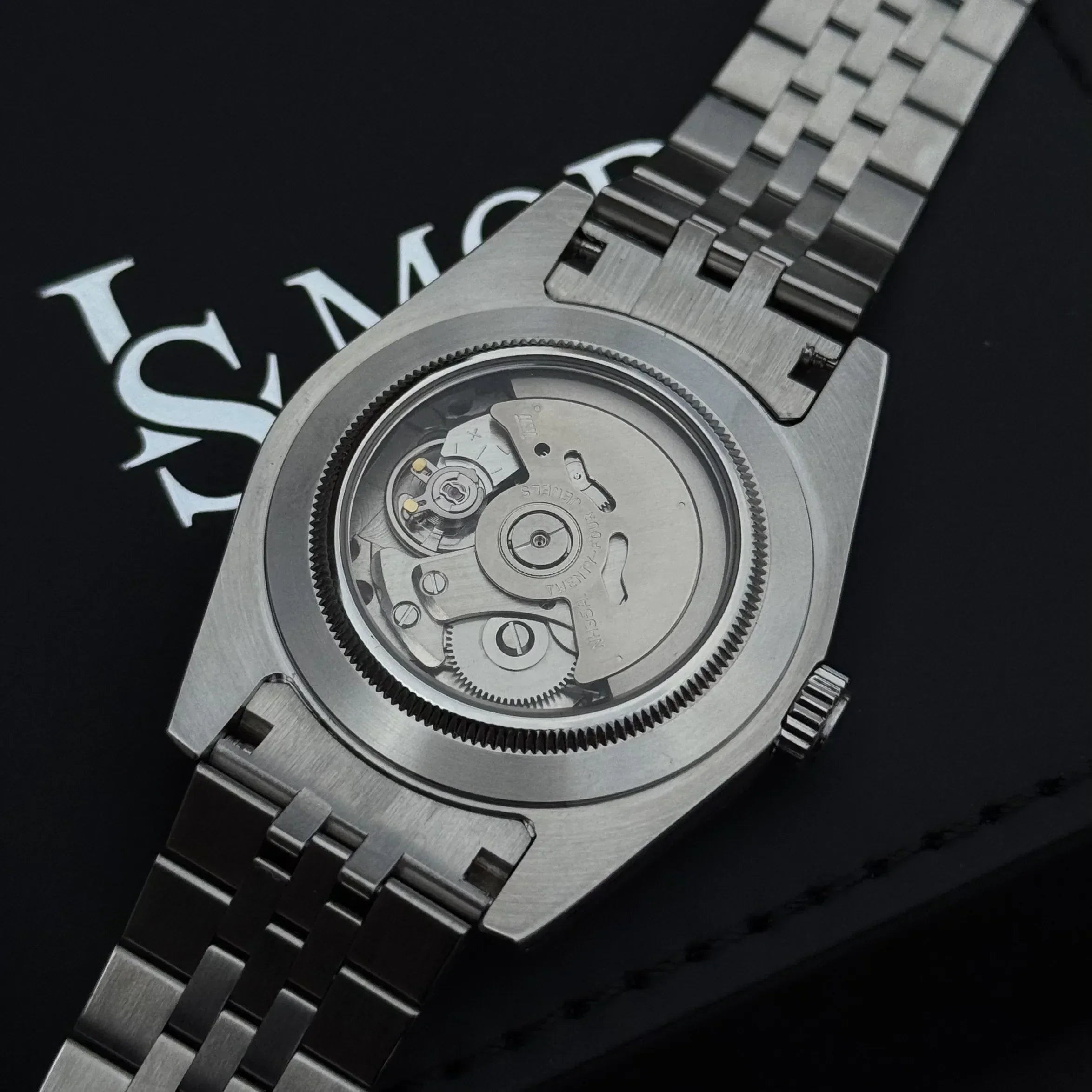
The Seiko NH35 is the movement that powers the vast majority of our models. It is found across the entire Datejust range, classic Royal Oak models and their variations (Arabic Dial, Frosted Metal, Rose Gold, Yellow Gold, Black Steel), classic Nautilus models, the Submariner, the Marine Master, the Aquanaut, and the Land Dweller.
Its characteristics according to official Seiko specifications: 24 jewels, a frequency of 21,600 vibrations per hour or 6 beats per second, a power reserve of approximately 41 hours, and an accuracy of -20 to +40 seconds per day. It displays hours, minutes, seconds, and the date.
Why this caliber over another? Because it combines three qualities rarely found at this price: documented reliability across millions of units, ease of maintenance by any qualified watchmaker, and long-term parts availability. Movements from the same generation produced in the 1980s are still functioning today.

The NH36: the invisible replacement
When the NH35 is temporarily out of stock, we use the NH36. The two calibers are practically identical: same dimensions, same architecture, same reliability. The only visible difference is that the NH36 adds a day-of-the-week indicator in addition to the date.
In practice, this difference is completely invisible on our watches: our dials do not feature a day window. The wearer experiences no difference between the two. That's why we do not differentiate these two calibers in our product descriptions.
The NH38: the open heart of the Nautilus Skeleton
The NH38 is a 3-hand automatic caliber without a date, from the same family as the NH35. It shares the same fundamental characteristics: 24 jewels, 21,600 vibrations per hour, a 41-hour power reserve, manual winding, and hacking.
Its particularity: it is partially skeletonized on the dial side, with a visible balance wheel from the front of the watch. This balance wheel, which oscillates 6 times per second, is the visible heart of the mechanism, the part you see dancing when you look at your watch.
This is the movement we use on the Nautilus Skeleton and Nautilus Skeleton Rose Gold models. The dial of these watches incorporates an open-heart window precisely positioned to reveal the oscillating balance wheel. Not a full skeleton, but a targeted opening on the most fascinating part of the movement.

The NH70: the full skeleton
The NH70 is a fully skeletonized version of the NH caliber. Where the NH35 hides its mechanism under an opaque dial and the NH38 allows a glimpse of its balance wheel, the NH70 exposes everything: mainplate, bridges, escapement wheel, balance wheel, barrel spring. The entire mechanism is visible through the dial and case back.
It equips all our models bearing the "Skeleton" mention in the Royal Oak range, i.e., the Royal Oak Skeleton and the Royal Oak Full Skeleton.
Technically, the NH70 shares the same basic architecture as the NH35: 19 jewels in this skeletonized configuration, same frequency of 21,600 vibrations per hour, same 41-hour power reserve. The difference is primarily aesthetic and conceptual: it is a movement designed to be looked at as much as it is worn.
We use the NH70 in a natural steel finish, for its understated and versatile appearance. It exists in tinted versions (NH71 black, NH72 gold) that we do not use, preferring the clarity of natural metal where the play of light works better.

The NH34: the true GMT for travelers
The NH34 is the only GMT caliber in our range, and it exclusively powers the GMT Master II model in the Submariner category. It is also our most technical model.
A true GMT is not just a bi-color bezel. It is a fourth hand, distinct from the three classic hands, that rotates over 24 hours and allows simultaneous reading of the time in a second time zone. The bi-color bezel, in turn, allows for visual distinction between day and night in this second time zone.
The NH34 is the caliber that makes all this possible. It adds this GMT complication on top of the standard NH architecture: 24 jewels, same frequency of 21,600 vibrations per hour, a 41-hour power reserve. The crown allows independent setting of the local time without shifting the reference time of the second time zone.
To clarify a point that some customers often ask us: the Marine Master GMT in our range has a decorative bi-color GMT bezel, but it is equipped with the classic NH35. It does not have a fourth hand. It is a GMT-inspired watch, not a true functional GMT. Only the GMT Master II in the Submariner category integrates the NH34 with the true GMT function.

The VK63: the meca-quartz chronograph
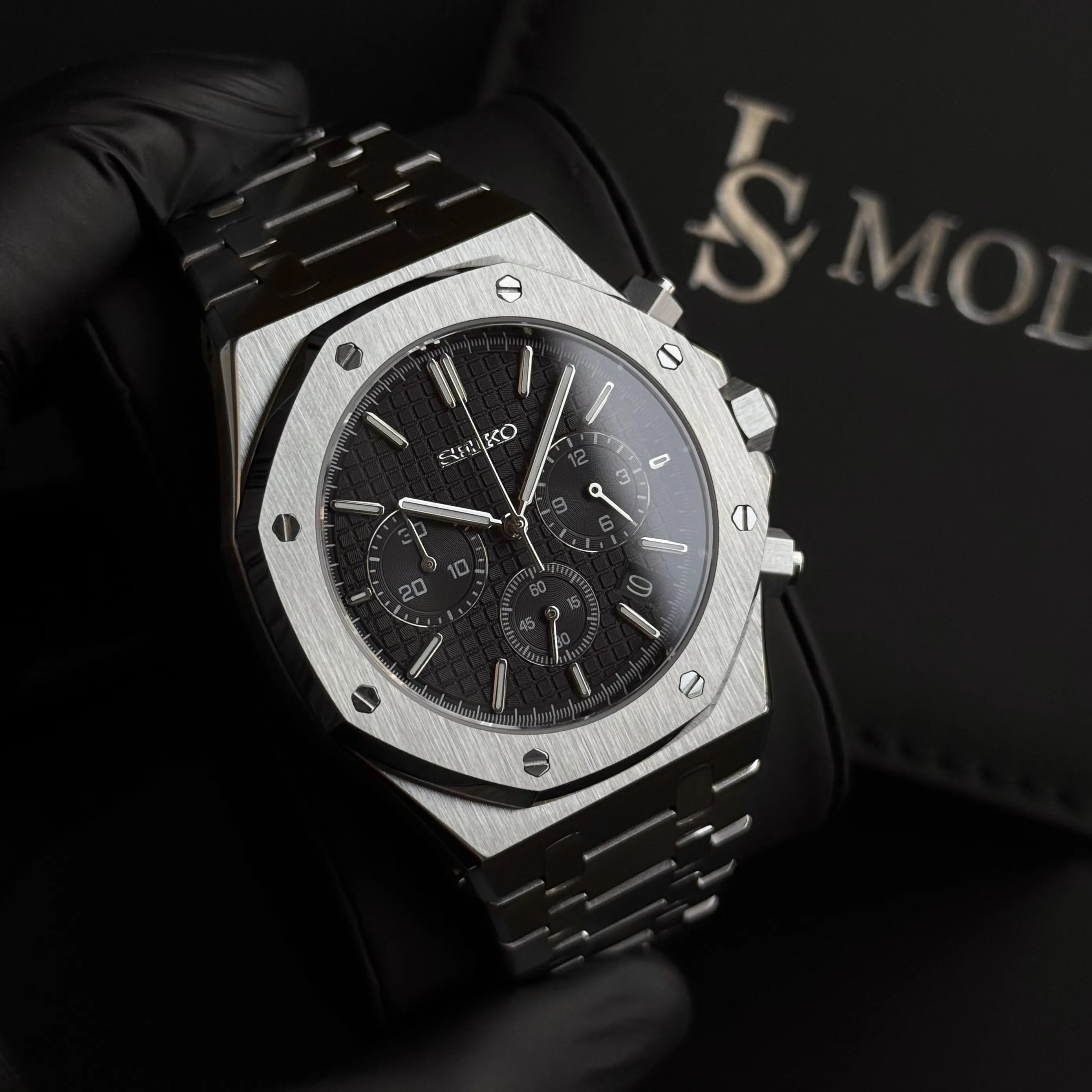
The VK63 is the only quartz movement in our range. It powers the Daytona models (all versions) and the Royal Oak Chronograph.
This caliber is also produced by Seiko Instruments Inc. But it's not an ordinary quartz: the VK63 is a meca-quartz movement, a hybrid technology where the chronograph functions are mechanically triggered, while time regulation is still provided by a quartz crystal. The result: accuracy of a few seconds per year, and smooth, continuous sweeping chronograph hands, without the characteristic jumps of low-end quartz movements.
Why quartz on these models and not automatic? Because an automatic caliber with true chronograph functions in this price range would either be too thick for our cases or too unreliable over time. The VK63 is the best technical choice for this type of watch.

Summary: which movement in which model
| Movement | Type | LSMods Models |
|---|---|---|
| NH35 | Automatic, date | Datejust, Royal Oak, Nautilus, Submariner, Marine Master, Aquanaut, Land Dweller |
| NH36 | Automatic, date + day | Occasional replacement for NH35, invisible difference |
| NH38 | Automatic, open heart | Nautilus Skeleton, Nautilus Skeleton Rose Gold |
| NH70 | Full skeleton automatic | Royal Oak Skeleton, Royal Oak Full Skeleton |
| NH34 | Automatic GMT | GMT Master II only |
| VK63 | Meca-quartz chronograph | Daytona, Royal Oak Chronograph |
Your questions about Seiko movements
What is the concrete difference between the NH35 and the NH38? The NH35 displays the date and completely hides the movement under the dial. The NH38 is a 3-hand version without a date, with a partially visible balance wheel from the front. On our Nautilus Skeleton models, this open heart aperture is the detail that changes everything.
Is the NH34 GMT more fragile than the NH35? No. The GMT complication adds mechanical complexity, but not additional fragility under normal conditions. The NH34 shares the same basic architecture as the NH35 and benefits from the same reliability standards.
Can the NH70 movement be seen without turning the watch over? Yes. The openworked dial of the Royal Oak Skeleton models allows the movement to be seen from the front, and the transparent case back reveals it from the back. It's a completely different visual experience from other models in the range.
Does the VK63 require a battery? Yes, it is the only movement in the LSMods range that runs on a battery. Battery life is generally two to three years depending on the use of the chronograph functions. Replacement can be done by any watchmaker in a few minutes.
Does the Marine Master GMT have a true GMT movement? No. The Marine Master GMT has a bi-color GMT-inspired bezel, but it is equipped with the classic NH35 without a fourth hand. Only the GMT Master II in the Submariner category integrates the NH34 with the true dual time zone function.
Can an NH movement be serviced by any watchmaker? Yes. NH calibers are among the most common automatic movements in the world. Any qualified watchmaker can service, adjust, or repair them without difficulty. This was one of the criteria that guided our choice of this family of movements from the outset.
How long do these movements last? With a service every five to ten years, NH calibers can function for several decades. Seiko movements of the same generation produced in the 1980s are still running today. This is one of the fundamental reasons why we chose Seiko as the basis for all our watches.
What beats under the dial matters as much as what is seen
A quality movement is what transforms a beautiful watch into a reliable piece for the long term. At LSMods, each caliber is precisely chosen for what it brings to the model it powers: the robustness of the NH35 for everyday wear, the mechanical poetry of the NH38 for open hearts, the total beauty of the NH70 for skeletons, the precision of the NH34 for true travelers, and the fluidity of the VK63 for chronographs.
Curious to see these movements in action? Browse our complete collection or directly configure your SeikoMod.

Leave a comment
All comments are moderated before being published.
This site is protected by hCaptcha and the hCaptcha Privacy Policy and Terms of Service apply.