
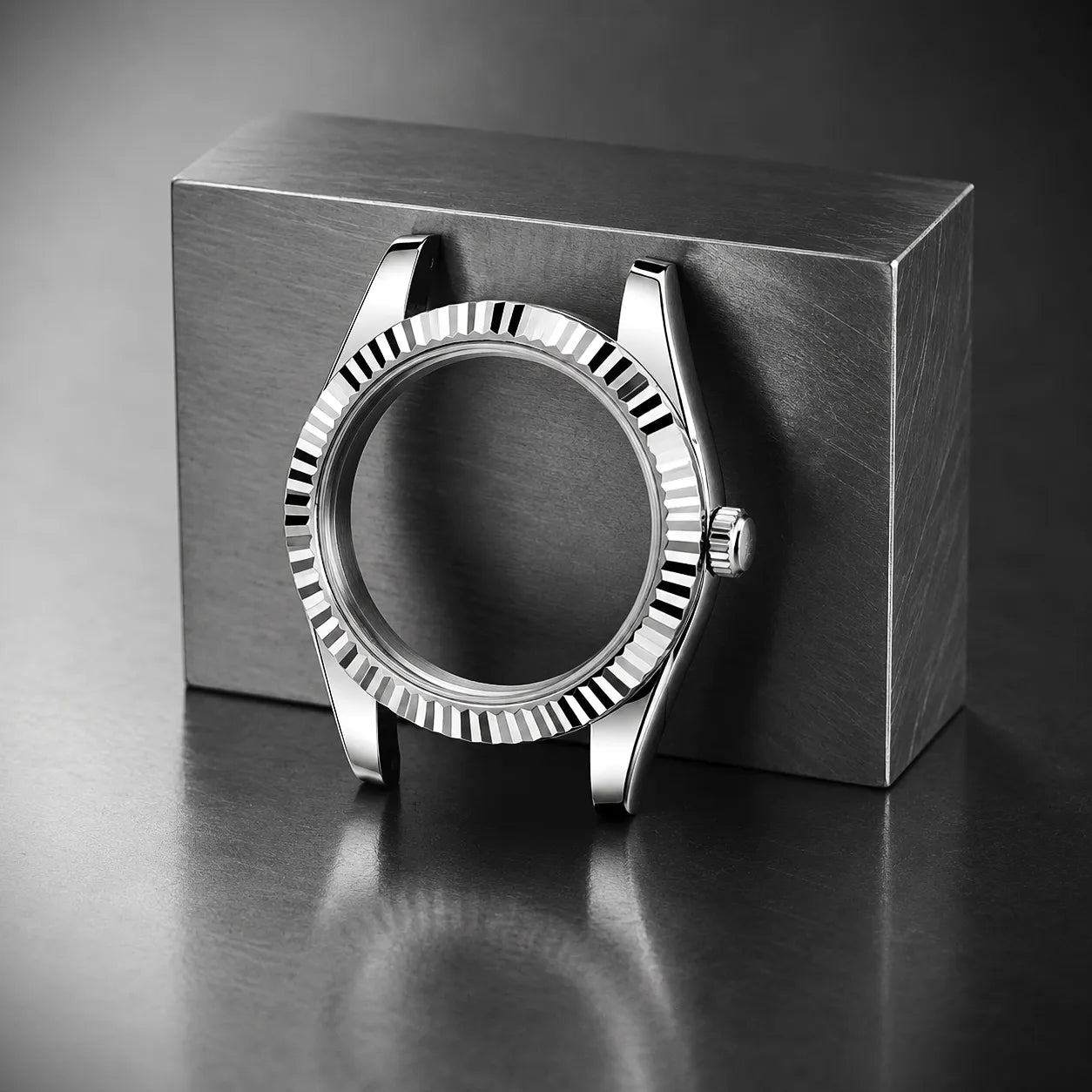
On a watch product sheet, you read "316L stainless steel case" or "904L steel". Two numbers, one letter, and a confusion that has lasted since a major Swiss brand decided to make it a marketing argument.
This guide separates fact from fiction, explains what these designations concretely mean, and tells you what really changes for a watch worn daily.
What is stainless steel?
Stainless steel is a metal alloy composed mainly of iron, chromium, nickel, and carbon. It is the chromium that gives it its rust resistance: it forms a transparent oxide layer on the metal's surface that protects the steel from external aggressions. The higher the chromium content, the stronger this protection.
The "L" in 316L and 904L stands for "Low carbon". Low-carbon steel is less prone to intergranular corrosion during welding and is generally more ductile, easier to machine, and polish. This is why both grades exist in the "L" version.

Composition: what truly distinguishes them
The difference between 316L and 904L is a matter of chemical composition. Both are austenitic steels, meaning they share the same crystal structure and similar general properties. What changes is the concentration of certain alloying elements.
316L contains approximately 16 to 18% chromium, 10 to 12% nickel, and 2 to 3% molybdenum. It is the most widely used stainless steel in the world, whether in watchmaking, medicine (scalpels, implants), food processing, or marine applications. Its reliability is documented over decades of intensive use in demanding conditions.
904L increases these concentrations: more chromium, more nickel, more molybdenum, and adds an amount of copper absent from 316L. It is a "super austenitic" steel, initially developed for extreme industrial applications such as heat exchangers in acidic environments, offshore oil platforms, or desulfurization systems in power plants.
Rolex was the first watch manufacturer to adopt 904L in 1985, renaming it "Oystersteel". Since then, this grade has been associated with luxury watchmaking in the collective imagination.
The misconception to correct: 904L is not harder
This is the most widespread confusion, fueled by certain marketing narratives.
904L is not harder than 316L. Both steels have a Rockwell hardness (HRB) of less than 95 and a mechanical strength of approximately 490 MPa, according to comparative industrial data. In terms of impact resistance and deformation, they are practically equivalent.
What 904L does offer, however, is better resistance to chemical corrosion in very aggressive environments: strong acids like sulfuric or phosphoric acid, environments with high chloride concentrations. These are conditions you will never encounter when wearing a watch daily.
For normal watch use—water, sweat, sea air—both steels perform perfectly. The difference in behavior between a 316L and 904L case is undetectable in the real life of a wearer.

What 904L truly brings to watchmaking
There are two concrete advantages of 904L specifically in the watchmaking context.
Polishing. 904L contains more chromium and an even lower carbon content than 316L, which allows it to achieve a deeper and brighter mirror finish after polishing. This is noticeable to the naked eye on a polished case: flat surfaces appear more "liquid," and reflections are sharper. This is a real advantage for a manufacturer like Rolex, whose mixed polished-brushed finishes are a visual signature.
Corrosion resistance in extreme conditions. If you regularly dive in deep seawater or expose your watch to chemicals, 904L offers an additional safety margin. For 99% of wearers, this margin will never be needed.
What 904L does not offer, contrary to what is sometimes claimed: neither additional lightness (it is slightly heavier than 316L at equal volume), nor superior shock resistance, nor increased scratch resistance.
Why 316L is the standard for serious watchmaking
316L steel is the most widely used grade in global watchmaking, and it's not a default choice. It's a deliberate technical choice.
It offers corrosion resistance that is more than sufficient for all daily uses. It is easier to machine and weld than 904L, allowing for more precise tolerances in the manufacturing of cases and bracelets. It is biocompatible and hypoallergenic: its low nickel content makes it compatible with sensitive skin, whereas 904L, with its higher nickel concentration, can cause reactions in people with allergies.
Brands like Audemars Piguet, Patek Philippe, IWC, Omega, and the vast majority of serious manufacturers use 316L. They are not compromising on quality. They are choosing the material suited to real-world use.

What we use and why
Our cases and bracelets are made from 316L stainless steel. This is the same grade used by Audemars Piguet, Patek Philippe, Omega, and almost all serious watchmaking outside of Rolex.
This choice is technical, not commercial. 316L is more ductile, allowing for more precise finishes on the edges and flat surfaces of our cases. Its biocompatibility makes it safer for wearers with sensitive skin. And its corrosion resistance is amply sufficient for normal use conditions: water, sweat, air, daily wear.
On some product sheets, you will see "316L and 904L steel" mentioned. This refers to the different parts of the watch: case and bracelet may use slightly different grades depending on the components and suppliers. The essential thing is that both are quality stainless steels, suitable for serious watchmaking use.
Your questions about watch steel
Is 904L really better than 316L for a watch? For normal daily use, no. Both offer more than sufficient corrosion resistance. 904L provides a brighter mirror finish and increased resistance to strong acids, advantages that are rarely relevant in the life of an ordinary wearer. In terms of hardness and shock resistance, the two are equivalent.
Why does Rolex use 904L if it's not really superior? Rolex adopted 904L in 1985 for its superior polishing qualities, consistent with its signature mixed finishes. It is a technical choice justified for their specific aesthetic. They then leveraged it as a marketing argument under the name "Oystersteel". Both steels are of very good quality in watchmaking.
Can 316L steel rust? Not under normal wearing conditions. The chromium oxide layer that naturally forms on the surface protects it from rust. Prolonged contact with certain aggressive chemicals can damage it, but this is rare in daily use. A rinse with clear water after exposure to the sea is sufficient for maintenance.
Is stainless steel hypoallergenic? 316L is more so than 904L, as it contains less nickel. For people with a confirmed nickel allergy, titanium remains the safest solution. If you've been wearing your watch without a reaction for several days, you have no problem with 316L steel.
How do I maintain a stainless steel case? Rinse with clear water after exposure to seawater. Wipe with a microfiber cloth to remove fingerprints. Light polishing is possible with a soft eraser on brushed parts if micro-scratches appear. Avoid abrasive products or scouring pads that can alter finishes.
What really matters about your watch case
The steel grade is one factor among others in the quality of a watch. What truly differentiates a good case from a bad one is the quality of the finishes, the precision of the adjustments between parts, the thickness of the walls, and the care taken in assembly.
A well-machined and well-finished 316L case is infinitely better than a poorly crafted 904L case. The steel grade opens up possibilities, the craftsman realizes them.
Discover our collection of 316L steel watches hand-assembled in our French workshop.

Leave a comment
All comments are moderated before being published.
This site is protected by hCaptcha and the hCaptcha Privacy Policy and Terms of Service apply.