
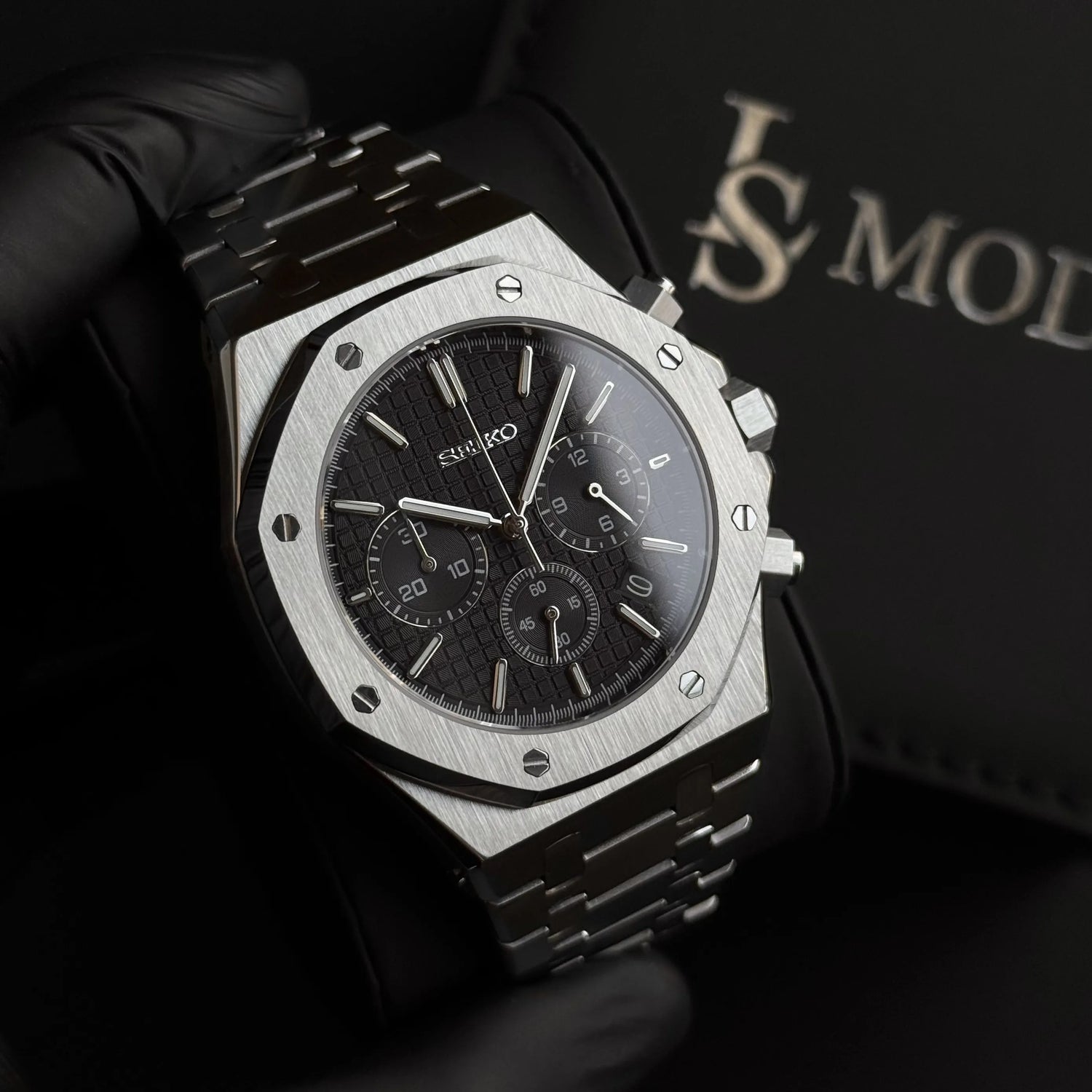
You're looking at a watch with two pushers on the side, three small sub-dials on the main dial, and a central hand that doesn't move. And you wonder what it's for.
This is the most frequent question we get about our Daytona, Royal Oak Chronograph, and Speedmaster models. This guide answers everything clearly, without unnecessary jargon.
What a Chronograph is, in one sentence
A chronograph is a watch that integrates two functions into a single case: time display like a classic watch, and an independent stopwatch that you can start, stop, and reset whenever you want.
The word comes from Greek: khrónos (time) and gráphô (to write). Literally, a watch that "writes time." This was the first chronograph in history, invented by the Frenchman Nicolas-Mathieu Rieussec in 1821, which worked with an ink-dipped hand leaving a trace on the dial. The principle hasn't changed since, only the mechanics have evolved.

What you see on a chronograph
A chronograph is immediately recognizable by several visual elements.
The two pushers. These are the two buttons located on the side of the case, usually at 2 o'clock and 4 o'clock. The top one (2 o'clock) starts and stops the stopwatch. The bottom one (4 o'clock) resets the hand to zero. Easy to remember: top for start/stop, bottom for reset.
The central chronograph hand. This is the large, thin hand that remains still until you press the pusher. It sweeps around the dial in 60 seconds to measure elapsed time. Do not confuse it with the regular seconds hand: on a chronograph, the normal seconds hand is relegated to one of the small sub-dials.
The sub-dials. The small circles on the main dial are used to count chronograph minutes and hours, and to display the watch's continuous seconds hand. A classic chronograph has three: one for the watch's permanent seconds, one for the timed minutes, and one for the timed hours.
The tachymeter bezel. The numbers engraved or printed on the bezel are used to calculate speed from a measured time. We'll come back to this.

How to use a chronograph
Three steps, in this order.
1. Press the top pusher (2 o'clock) to start. The central hand starts immediately. The minute sub-dial begins to advance after 60 seconds.
2. Press the top pusher again to stop. The hand freezes. You read the elapsed time on the central hand (seconds) and on the minute sub-dial.
3. Press the bottom pusher (4 o'clock) to reset. The hands return to their initial position. You are ready for a new measurement.
A practical tip: avoid leaving the chronograph running unnecessarily. On a quartz watch like our Daytona and Royal Oak Chronograph models equipped with the VK63, this accelerates battery consumption.
What is a chronograph actually used for?
The honest answer: in modern daily life, to measure any time interval without pulling out your phone. The cooking time of a dish, the duration of a meeting, a sports interval.
Historically, the chronograph was developed for specific uses. Race car drivers used it to time laps. Aviators to calculate their remaining fuel. Doctors to measure pulse with the pulsometer. Military personnel to calculate distances with the telemeter scale.
Today, the majority of people buy a chronograph for its sporty aesthetic as much as for its function. A dial with three sub-dials and two pushers has a visual presence that a three-hand watch does not. This is accepted, and it's a good reason to buy one.
The tachymeter: what are these numbers on the bezel for?
This is the most frequent question after "what are the small dials for?".
The tachymeter allows you to calculate a speed from a measured time over a fixed distance of one kilometer. Concrete example: you want to know how fast you are cycling over an exactly one-kilometer stretch. You start the chronograph at the beginning of the kilometer, you stop it at the end. The hand points to a number on the bezel: this is your speed in km/h.
If your kilometer took 45 seconds, the hand points to 80 on the scale, meaning 80 km/h. This is a simple mathematical calculation (3600 divided by the number of seconds) that the bezel does visually for you.
In daily practice, few wearers actually use the tachymeter. But it contributes to the visual identity of the racing chronograph, and on models like the Daytona, it is an integral part of the design.

Chronograph and chronometer: the most common confusion
Many people use the two words interchangeably. This is a mistake, and understanding it avoids disappointment when purchasing.
A chronograph is a function: it is the ability to measure a time interval. Any watch can be a chronograph.
A chronometer is a quality label, not a function. It is a certification issued by COSC (Contrôle Officiel Suisse des Chronomètres) after rigorous tests over several days, at different temperatures and positions, certifying that the watch displays time with a maximum precision of -4/+6 seconds per day.
A watch can be both: this is the case with the Rolex Daytona, which is a chronometer-certified chronograph. But the vast majority of chronographs on the market are not chronometer-certified. This is not necessarily a flaw, it's simply information to have.
Our Daytona, Royal Oak Chronograph, and Speedmaster models use the Seiko Instruments VK63 mecha-quartz movement. This movement is not COSC certified, but offers a standard quartz precision of a few seconds per year, amply sufficient for daily use.
The mecha-quartz movement: why our chronographs are quartz-powered
This is a legitimate question for someone who knows that our other watches are automatic.
A mechanical automatic chronograph is an extremely complex complication: dozens of additional parts, a thicker case, a significantly higher production price, and increased fragility. In the accessible price range, offering a serious automatic chronograph is very difficult without significant compromises on quality.
The Seiko Instruments VK63 is a smart hybrid solution. It is a mecha-quartz movement: the mechanism that triggers the chronograph hands is mechanical, which gives that satisfying and fluid feel when you press the pushers. Timekeeping is provided by quartz, for optimal precision. The central chronograph hand sweeps continuously, without jumps, unlike cheap pure quartz movements.
The result: a chronograph that works reliably, easily serviced by any watchmaker, with a battery life of 2 to 3 years.

The three chronographs in our range
The SeikoMod Daytona is inspired by the Rolex Cosmograph Daytona, the absolute reference in racing chronographs. 40mm case, tachymeter bezel, three signature "panda" or colored sub-dials depending on the version. It is our sportiest and most assertive interpretation.
The SeikoMod Royal Oak Chronograph combines the sport-chic octagonal aesthetic of the Royal Oak with chronograph functions. Tapisserie dial, integrated bracelet, 41mm case. For those who want an elegant as well as functional chronograph.
The SeikoMod Speedmaster is inspired by the Omega Speedmaster, the astronaut's watch worn on the Moon during Apollo 11 in 1969. Simple dial, black bezel, timeless design. Our reference for enthusiasts of watchmaking and space history.
All three models are equipped with the Seiko Instruments VK63 and deliver a reliable chronograph for everyday use.
Your questions about chronograph watches
What is the difference between a chronograph and a chronometer? A chronograph is a time-measuring function on a watch. A chronometer is a precision label issued by COSC after rigorous testing. The two concepts are independent: a chronograph may or may not be chronometer-certified.
How do you reset a chronograph? By pressing the bottom pusher (usually at 4 o'clock). Be careful: on most chronographs, you must first stop the chronograph before resetting it. Resetting while running can damage the mechanism on mechanical movements.
Can the chronograph be left running permanently? On a quartz movement like the VK63, it's not advisable as it accelerates battery consumption. On an automatic, it unnecessarily engages additional parts. In practice, use the chrono for what it is: a punctual measurement.
Does the chronograph also count hours? Yes. The chronograph hour sub-dial can generally count up to 12 hours of continuous measurement, depending on the movement. For our VK63 models, the chronograph can measure up to 12 consecutive hours.
Are our chronographs waterproof? Yes. All our chronograph models are tested for water resistance before shipping. The pushers are protected for normal daily use. However, avoid operating them underwater.
What is the battery life of the VK63? Between 2 and 3 years with normal use. Replacement can be done by any watchmaker or jeweler in a few minutes, at a cost of 10 to 20 euros depending on the provider.
A measuring tool that is also a style object
The chronograph is the most widespread watch complication in the world, and for good reason: it adds real visible functionality without making the watch illegible. Two buttons, a few extra dials, and you have something in your hands that does more than just tell the time.
For the curious and enthusiasts, it's also a gateway into the history of watchmaking. From Rieussec's ink pencil in 1821 to the VK63 mecha-quartz, two centuries of ingenuity in a 40mm case.
Discover our range of chronographs or browse our entire collection.


Leave a comment
All comments are moderated before being published.
This site is protected by hCaptcha and the hCaptcha Privacy Policy and Terms of Service apply.