Two watches. Same case, same dial, similar price. One is battery-powered, the other winds itself thanks to your wrist. But which one truly deserves your money?
This is the question most buyers ask before their first serious watch. And the answer depends entirely on what you're looking for. Price, precision, maintenance, lifespan, emotion: we compare everything, without mincing words.
What's under the hood
Before comparing, it's important to understand what differentiates these two technologies.
A quartz watch works with an electric battery that vibrates a quartz crystal at 32,768 oscillations per second. This signal regulates an electronic chip that controls the hands. Simple, reliable, precise.
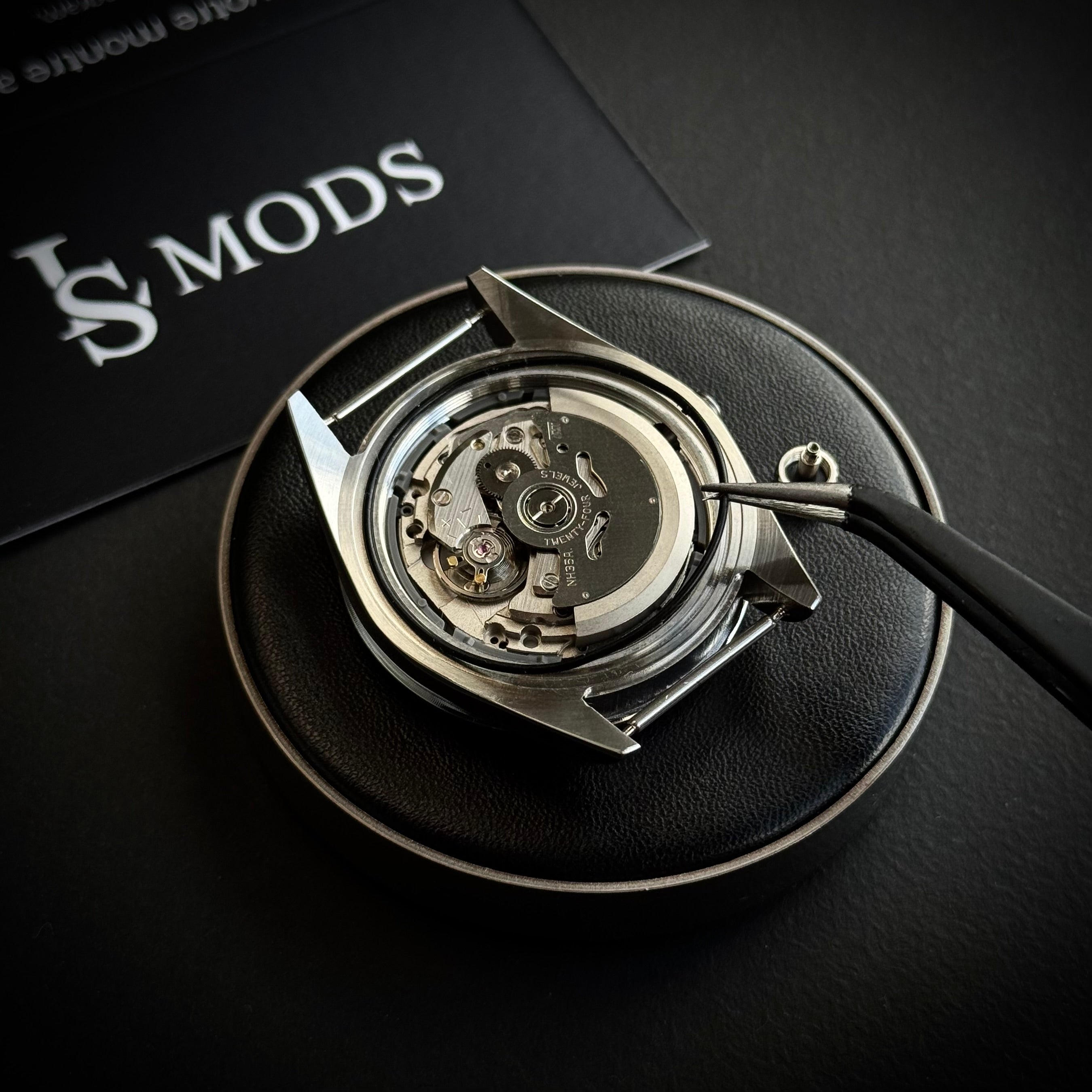
An automatic watch is an entirely mechanical watch. It contains between 100 and 300 miniature parts: springs, levers, wheels, and jewels that articulate to measure time. It winds itself through the natural movement of the wrist, via a rotating rotor that tensions the mainspring. No battery, no electronics, ever.
It is this fundamental difference that explains everything else: the price, the maintenance, the lifespan, and that particular feeling one gets from wearing one or the other.

Accuracy: quartz wins, but that's not what really matters
On this point, quartz is undeniably superior. A good quartz watch deviates by 15 seconds per year under normal conditions. An automatic movement like the Seiko NH35, a 24-jewel Japanese automatic caliber used in all our SeikoMods, has a tolerance of -20 to +40 seconds per day according to official Seiko specifications, depending on temperature and position during sleep.
But in real life, a few seconds a day doesn't change anything. You check the time on your watch, not on an atomic chronometer. And if absolute precision obsesses you, your phone is already there for that, constantly synchronized.
What matters more is what the watch represents. On this ground, the two technologies really don't have the same story to tell.
Maintenance: two opposing philosophies
A quartz watch requires almost nothing. Change the battery every two to four years, and that's it. Practical, zero constraints, you forget it's on your wrist.
An automatic watch requires more attention. You need to wear it regularly or wind it manually if it remains stationary longer than its power reserve. The NH35 has a 41-hour reserve, which is a full weekend without wearing it. A service every five to ten years by a watchmaker is recommended to lubricate the parts and check the water resistance.
But this care creates a bond. Many automatic watch owners describe a particular attachment to their piece, precisely because it lives with them. It stops when you no longer wear it. It starts again when you put it back on your wrist. It's a metaphor that resonates with quite a few people.

Price: quartz unbeatable at entry-level, surpassed beyond
Below 100 euros, quartz clearly dominates. The technology is inexpensive to produce and the results are reliable. Brands like Seiko or Casio offer excellent quartz watches in this range.
Beyond 200 euros, the situation changes. For an equivalent budget, an automatic watch offers something that quartz cannot match: visible mechanics, a watchmaking tradition spanning several centuries, a piece that can be passed down. This is the positioning of LSMods SeikoMods, equipped with the Seiko NH35 movement and hand-assembled in France between 250 and 500 euros. For this budget, sapphire glass, 316L steel, a quality automatic movement, and a unique piece are on offer.
| Quartz | Automatic | |
|---|---|---|
| Accuracy | ±15 seconds/year | ±20 seconds/day |
| Maintenance | Battery every 2-4 years | Service every 5-10 years |
| Entry-level price | From 20 euros | From 100 euros |
| Lifespan | 10-20 years | Several decades |
| Winding | Via battery | Via wrist or crown |
| Customization | Limited | Total |
| Mechanical emotion | None | Real |
Lifespan: automatic thinks long-term
This is the most underestimated argument in this debate.
A quartz watch has a limited lifespan due to its electronic components. After 15 to 20 years, some chips are no longer available, some manufacturers no longer provide after-sales service. The watch ends up in a drawer.
A well-maintained mechanical movement can operate for generations. Automatic watches from the 1960s are still running today because their parts are universal and any qualified watchmaker can service them. This is why mechanical watches are given as gifts: they are made to last beyond a lifetime, not to be replaced in two years.

What quartz will never do
There's one thing quartz will never do, no matter its price. It won't make you want to look at your watch just for the pleasure of looking at it.
An automatic watch with a transparent case back allows you to see the ballet of gears, the swing of the rotor, the dance of the balance wheel oscillating 6 times per second in the case of the NH35. It's alive. Some models, like the skeleton SeikoMod Royal Oak, go even further by leaving the movement visible through the dial itself.
This is a dimension that technical specifications do not capture. But it's often what sways the decision.
Quartz or automatic: the verdict according to your profile
Choose quartz if you need extreme precision for a specific activity like technical diving or chronometry, if your budget is under 100 euros, or if you want a truly maintenance-free watch.
Choose automatic if you want a watch that tells a story. If you like the idea that it lives because of you. If you are looking for an object that ages well rather than becoming obsolete. If you want value for your money in the long run.
For an everyday watch, a style accessory, or a lasting gift: automatic wins as soon as the budget exceeds 200 euros. Below that, quartz is often more reasonable.
And what about SeikoMods?
Almost the entire LSMods range revolves around the Seiko NH35 automatic movement: automatic and manual winding caliber, 24 jewels, bidirectional rotor, stop-seconds for precise time setting, 41-hour power reserve. A movement documented on millions of units worldwide for decades.
The only exception: Daytona models, equipped with a Seiko Instruments VK63 quartz chronograph movement. This is the only case where quartz really stands out, because no accessible automatic movement reproduces chronograph functions so faithfully at this price.
For the rest of the range, the choice has been clear from day one.

Your questions about automatic vs quartz
Can an automatic watch stop if it's not worn? Yes. The NH35 has a power reserve of 41 hours. Beyond that, the spring unwinds and the watch stops. Simply wind it manually via the crown by turning it 20 to 30 times clockwise, or shake it for a few seconds to restart the rotor. This is normal and has no consequences for the movement.
Is quartz really more reliable in everyday life? In pure accuracy, yes. In mechanical longevity, a quality automatic movement like the NH35 is just as reliable, if not more so: it has no electronic components that age and become unobtainable. Seiko movements from the 1970s are still running perfectly today.
Can an automatic watch be hand-wound? Yes. The NH35 has manual winding via the crown, in addition to automatic winding by the wrist. 20 to 30 turns are enough for a full day. This is useful after a weekend without wearing it.
Are all LSMods SeikoMods automatic? Almost all. The Daytona range uses a VK63 quartz chronograph movement. All other models, Nautilus, Royal Oak, Datejust, Submariner, Marine Master, Aquanaut, and Land Dweller, are equipped with the automatic Seiko NH35.
How long does a Seiko NH35 movement last? With a service every 5 to 10 years, the NH35 can operate for several decades. It shares its basic design with Seiko calibers produced since the 1970s, many of which are still working perfectly today.
What is the price difference between quartz and automatic at LSMods? The choice of movement is not the main variable. Our automatic models and Daytona quartz models are in the same range of 250 to 500 euros. It is the model and finishes that determine the final price.
Mechanics, a lifestyle choice
Choosing an automatic watch means choosing to wear something with a history. Each beat comes from a spring, a wheel, a fragile balance between invisible parts that have been articulating for over a century according to the same principles. It is the opposite of disposable.
At LSMods, all our watches are built around Seiko automatic movements, hand-assembled in our French workshop. Because we believe mechanics deserve better than a AAA battery.
Want to see our models? Discover our collection of custom automatic watches or directly configure your custom SeikoMod.


Leave a comment
All comments are moderated before being published.
This site is protected by hCaptcha and the hCaptcha Privacy Policy and Terms of Service apply.